Health and Medication Journal for KDP: A Creator’s Guide
Creating a successful low-content book requires more than just uploading a generic template; it demands a deep understanding of user utility and market specificity. The Health and Medication Journal for KDP represents a shift toward functional, high-value interiors that solve genuine problems for end-users. For publishers, designers, and entrepreneurs in the digital product space, this resource offers a streamlined pathway to creating professional-grade health trackers without the overhead of custom layout design. By providing editable source files in PPTX, Keynote, and PDF formats, this journal template empowers creators to launch niche-specific health products that stand out in a saturated marketplace.
Strategic Value for Digital Publishers
The primary advantage of this specific journal architecture lies in its technical flexibility. Many KDP creators struggle with software barriers or expensive subscriptions to Adobe InDesign. This Health and Medication Journal for KDP circumvents those hurdles by utilizing Google Slides-compatible PPTX files. This accessibility allows marketers, bloggers, and educators to edit, customize, and rebrand the interior using free, browser-based tools. The ability to right-click and duplicate pages or delete unnecessary sections means you are not locked into a rigid structure. You can adapt the 100-day format to a 30-day challenge, a 90-day wellness sprint, or a comprehensive annual medical log simply by adjusting the page count before export.
From a business perspective, the specifications are optimized for profitability. With a 6x9 inch trim size, black and white interior, and no bleed requirements, the printing cost sits at an accessible $2.15. This price point allows for competitive retail pricing while maintaining healthy royalty margins. For small business owners and freelancers looking to diversify income streams, this balance of low production cost and high perceived value is essential. The document has been pre-tested on the KDP previewer, significantly reducing the risk of formatting errors, rejected uploads, or wasted proof copies.
Anatomy of a Functional Health Tracker
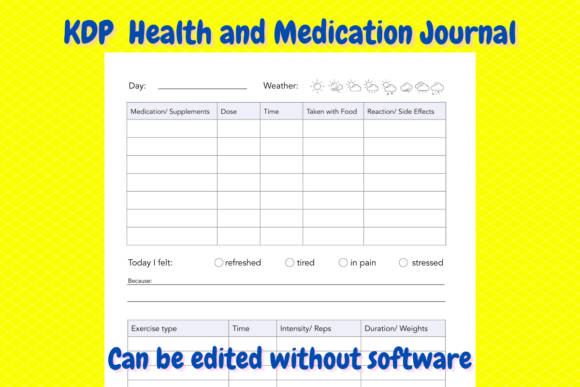
Understanding the interior layout is crucial for marketing the final product effectively. This journal is designed with data correlation in mind, moving beyond simple checklists to holistic health monitoring. Each of the 100 daily pages begins with contextual metadata: date and weather. While seemingly minor, weather tracking is vital for users managing migraines, arthritis, or seasonal affective disorder, allowing them to identify environmental triggers over time.
The core medication table is structured for safety and compliance. It includes columns for name, dose, time, food intake status, and reactions or side effects. This level of detail transforms the journal from a passive diary into an active medical tool. Patients can bring this record to doctor appointments to provide accurate history regarding drug efficacy and adverse reactions. Following the medication log, the layout provides dedicated space for subjective feeling assessments, objective health markers like blood glucose and heart rate, meal logging, and exercise tracking. The inclusion of a "positive note" section integrates mental wellness into physical health tracking, appealing to the growing holistic health demographic.
Creative Adaptations and Niche Targeting
The true power of this Health and Medication Journal for KDP emerges when creators adapt it for specific audiences rather than targeting the general public. The editable nature of the PPTX and Keynote files allows for strategic pivots that align with distinct sub-niches.
- Chronic Illness Management: Customize the health markers table to focus on specific conditions. For a fibromyalgia tracker, replace generic metrics with pain scale ratings and sleep quality scores. For diabetes management, emphasize blood glucose and insulin timing. The brand name page allows you to position the book as a specialized medical companion rather than a generic notebook.
- Fitness and Nutrition Coaching: Personal trainers and nutritionists can use this template as a client lead magnet or paid digital download. Modify the exercise table to include sets, reps, and RPE (Rate of Perceived Exertion). Use the title page and branding page to reinforce your coaching identity, turning a simple journal into an extension of your service ecosystem.
- Mental Health and Therapy: Therapists and counselors can adapt the medication section to track psychiatric prescriptions alongside mood journals. Expand the "how I felt" section to include CBT-based prompts or gratitude exercises. The positive reflection space at the bottom of each page serves as a natural anchor for cognitive reframing practices.
- Elder Care and Caregiving: Create a version specifically for caregivers managing medications for aging parents. Simplify the language, increase font sizes within the editable file, and add sections for caregiver notes or emergency contacts. This addresses a massive, underserved demographic seeking organization amidst caregiving complexity.
Design Consistency and User Experience
When customizing this Health and Medication Journal for KDP, maintaining visual consistency is paramount. Because the interior is black and white with no bleed, contrast becomes your primary design tool. Ensure that any added branding elements or modified table headers remain legible when printed on standard KDP paper stock. Avoid heavy ink coverage or grayscale gradients that may print muddy. Stick to clean lines, ample white space, and high-contrast typography.
User experience should drive every modification. If you duplicate pages to extend the journal beyond 100 days, ensure the binding margin remains consistent so writing near the spine remains comfortable. If you add new tracking categories, test the spacing to ensure users have adequate room to write by hand. Remember that the end-user is likely tracking health data during moments of stress or fatigue; clarity and ease of use are more valuable than decorative flourishes. The pre-formatted tables in this template provide a professional baseline that handwritten notebooks cannot match, but only if the customization respects the original functional intent.
Leveraging Multi-Format Flexibility
The inclusion of PDF, PPTX, and Keynote files serves different stages of the creation workflow. Use the PPTX file for heavy editing, restructuring, and rebranding within Google Slides or PowerPoint. Utilize Keynote if you prefer Apple’s ecosystem for precise typographic adjustments. Reserve the PDF for final review and direct upload when no changes are needed. This multi-format approach future-proofs your asset library, ensuring you can revisit and update the journal as KDP specifications evolve or as you expand into adjacent niches.
For educators and workshop leaders, these files offer secondary utility beyond KDP publishing. The same journal used for a paperback listing can be distributed as a digital workbook in health education courses, corporate wellness programs, or community support groups. The branding page makes it easy to co-brand with partner organizations or sponsors, opening B2B revenue channels alongside direct-to-consumer sales.
Practical Implementation Recommendations
Before launching your adapted Health and Medication Journal for KDP, conduct thorough keyword research specific to your chosen niche. Generic terms like "health journal" are highly competitive, but long-tail phrases like "medication tracker for elderly parents" or "migraine weather journal" often have lower competition and higher conversion intent. Align your title, subtitle, and backend keywords with the specific modifications you’ve made to the interior.
Consider creating a series rather than a standalone product. Use the same base template to create variations for different demographics or conditions, establishing brand recognition across multiple listings. The efficiency of the editable PPTX file makes series expansion feasible for solo creators. Always order a physical proof copy after making significant edits to verify that table alignment, font sizes, and writing spaces function as intended in print. Digital previews cannot replicate the tactile experience of writing in a 6x9 journal, and user reviews often hinge on these physical usability factors.
Ultimately, this journal template represents a foundation for building a sustainable publishing business grounded in genuine utility. By focusing on specific user needs, maintaining professional design standards, and leveraging the technical flexibility of editable source files, creators can transform a simple tracking tool into a valuable health resource. The intersection of practical functionality and creative adaptation is where successful KDP products thrive, and this Health and Medication Journal provides the exact framework needed to execute that vision effectively.