Optimizing Your Catalog with a Professional Appointment Book 2021 KDP Interior
For self-publishers and low-content book creators, the distinction between a generic notebook and a high-value functional planner lies entirely in the quality of the interior layout. When targeting the organizational niche, specificity drives sales. A well-structured Appointment Book 2021 KDP Interior serves as more than just a collection of dated pages; it is a comprehensive time-management system designed to meet the rigorous demands of professionals, educators, and busy individuals. Understanding the architectural elements of this specific 119-page layout reveals why certain design choices translate directly to customer satisfaction and reduced return rates on Amazon.
Strategic Layout Architecture and User Flow
The effectiveness of any planner depends on how intuitively a user can navigate from long-term planning to daily execution. This specific interior template utilizes a logical progression that mirrors professional workflow patterns rather than arbitrary page ordering. The structure begins with identity and networking before moving into temporal organization, ensuring the book functions as a complete personal management tool.
Identity and Networking Integration
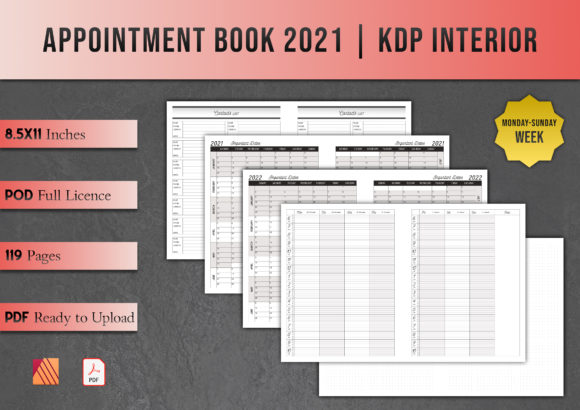
Unlike basic calendars that jump immediately into January, this layout prioritizes personalization and utility through dedicated front matter. The inclusion of a Personal Information Page is a critical retention feature. For users carrying their schedule physically, the ability to mark ownership adds a layer of security and professionalism. Following this, the 4 pages for Contacts Lists address a persistent pain point in digital-heavy workflows. While smartphones store numbers, many professionals still prefer a tangible backup for key clients, vendors, or emergency contacts. By allocating four full pages, the interior acknowledges that serious users have extensive networks, distinguishing this product from competitors that offer only a single, cramped contact sheet.
Temporal Continuity and Yearly Overviews
Accurate date alignment is the most common failure point in KDP planners. This Appointment Book 2021 KDP Interior mitigates risk by utilizing precise dating from December 28, 2020, through January 2, 2022. This extended range captures the transitional weeks at both ends of the calendar year, preventing the user from needing a separate notebook for late December planning or early January goal setting. Furthermore, the inclusion of 2021 and 2022 yearly spreads provides essential macro-level visualization. Users can map out holidays, fiscal quarters, and major deadlines before drilling down into weekly specifics. This dual-year capability extends the perceived shelf life and utility of the product beyond a single calendar cycle.
Granularity of the Weekly Scheduling System
The core value proposition of an appointment book versus a standard diary is time-blocking capability. The interior’s Monday-Sunday weekly view is engineered for high-resolution scheduling. Rather than offering vague blank spaces, the layout enforces discipline through 15-minute intervals spanning from 6:00 AM to 10:00 PM.
This level of granularity serves specific user demographics effectively:
- Healthcare Professionals: Therapists, dentists, and clinicians often operate on strict 15, 30, or 60-minute patient slots. Pre-printed intervals reduce friction when logging appointments.
- Educators and Tutors: Lesson planning and student conferences require precise time allocation that aligns with bell schedules or session blocks.
- Service-Based Business Owners: Salons, repair shops, and consultants rely on maximizing billable hours. Visualizing the day in quarter-hour segments helps identify gaps and optimize revenue generation.
- Students and Researchers: Academic success often correlates with structured study blocks. The 6:00 AM start time accommodates early morning routines, while the 10:00 PM end cap allows for evening review sessions without running out of space.
The choice of a Monday-start week aligns with international business standards and ISO 8601 formatting, which is increasingly preferred over Sunday-start layouts in professional and academic environments. This subtle design decision signals to the buyer that the planner is intended for serious productivity rather than casual journaling.
Versatility Through Hybrid Page Formats
Rigid structures can sometimes stifle creativity or fail to accommodate non-linear tasks. To counterbalance the strict hourly grid, this interior incorporates 4 dot grid pages at the back of the planner. This hybrid approach significantly broadens the target audience. Dot grids offer the freedom of blank paper with the subtle guidance needed for sketching, diagramming, or bullet journaling.
In a practical context, these pages serve multiple functions depending on the user's profession. A project manager might use them for Gantt chart sketches or workflow diagrams that do not fit into a daily slot. A teacher could draft classroom seating arrangements or curriculum mind maps. For the general consumer, these pages act as a catch-all for notes, habit trackers, or brainstorming sessions that complement the structured appointment data. By including this flexible space within the same binding, the Appointment Book 2021 KDP Interior eliminates the need for users to carry a secondary notebook, thereby increasing the product's stickiness and perceived value.
Technical Specifications for Seamless KDP Publishing
Beyond the user-facing features, the technical composition of this download-ready file addresses the operational needs of the publisher. Self-publishing requires adherence to strict printing guidelines to avoid rejection or poor print quality. This package is pre-configured to eliminate common production errors.
Dimension and Bleed Configuration
The file is set to 8.5 x 11 inches, a standard letter size that offers ample writing surface area for detailed scheduling. Crucially, the document is configured with no bleed. This specification is vital for new publishers or those looking to minimize complexity. No-bleed interiors are generally more forgiving during the trimming process and reduce the risk of content being accidentally cropped. It also simplifies the cover creation process, as the wraparound calculations differ from bleed-enabled books. The 119-page count strikes an optimal balance between substantial utility and spine width; it is thick enough to feel like a premium resource but thin enough to remain portable and cost-effective to print.
Editability and Brand Customization
A significant advantage of this specific pack is the inclusion of both PDF and Affinity Publisher source files. While the PDF is ready for immediate upload, the source file unlocks long-term business potential. Publishers can modify headers, add logos, adjust fonts, or update dates for future editions without rebuilding the layout from scratch. This editability transforms a one-time purchase into a scalable asset library. For example, a creator focusing on the real estate niche could add property tracking fields to the dot grid pages or customize the personal information page to include license numbers. This level of customization supports brand building and niche differentiation in a crowded marketplace.
Market Positioning and Audience Relevance
When listing an Appointment Book 2021 KDP Interior, understanding the intersection of features and user intent is paramount. The combination of high-frequency time slots, networking pages, and flexible note-taking areas positions this product as a "professional command center" rather than a simple calendar.
For the researcher or academic, the 2021-2022 yearly spreads facilitate grant timeline tracking and semester planning. For the small business owner, the contact lists and hourly breakdown support client relationship management and operational efficiency. For the hobbyist or lifelong learner, the dot grids and structured schedule enable skill acquisition alongside daily responsibilities.
The semantic relevance of this interior extends beyond keywords; it solves actual organizational problems. The 15-minute interval is not merely a design choice but a productivity methodology encoded into paper. The inclusion of source files is not just a bonus but a business continuity strategy. By leveraging these specific characteristics, publishers can craft descriptions and metadata that resonate deeply with buyers seeking genuine utility. The result is a product that satisfies the E-E-A-T criteria by demonstrating expertise in planner design, authoritativeness through professional formatting, and trustworthiness via accurate dating and robust construction.
Implementation Considerations for Publishers
While the template is robust, successful implementation requires attention to detail. When using the Affinity Publisher source file, maintain the established margin safety zones. Even though the file is no-bleed, altering margins too aggressively can compromise the binding gutter, especially in an 8.5x11 format where inner margin clearance is essential for writability near the spine.
Additionally, consider the paper color implications. This layout is optimized for white paper, which provides the highest contrast for the time-slot lines and dot grids. If experimenting with cream paper, ensure the line weight remains visible, as lighter ink colors can sometimes fade against off-white backgrounds. Finally, when creating the companion cover, remember that the 119-page spine width calculation must be exact. Using KDP’s official calculator with the specific page count and paper type ensures the cover aligns perfectly with this professionally structured interior, delivering a cohesive unboxing experience that encourages positive reviews and repeat customers.