Streamlining Self-Publishing with a No-Bleed Dream Journal KDP Template
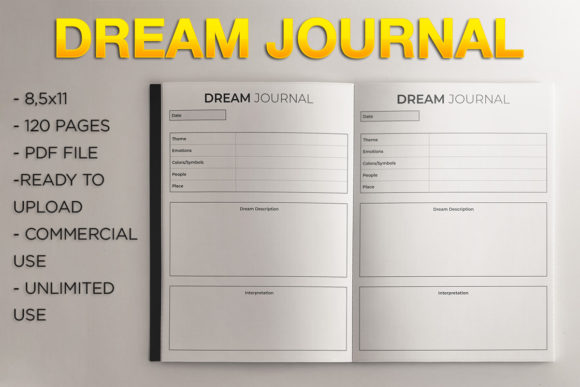
The intersection of mental wellness and self-publishing has created a significant niche for low-content books, particularly those designed for subconscious exploration. For creators looking to enter this market, technical precision is just as important as thematic resonance. Utilizing a specialized Dream Journal KDP Template eliminates the most common production errors associated with Amazon’s print-on-demand platform. Specifically, an 8.5″ x 11″ no-bleed design offers a standardized, professional foundation that balances aesthetic appeal with manufacturing safety. This format serves as a critical tool for authors, educators, and researchers who wish to provide a functional resource without navigating the complexities of custom graphic design or trim-size calculations.
Technical Specifications and Manufacturing Safety
Understanding the physical parameters of the template is essential for ensuring a seamless upload process to Kindle Direct Publishing. The 8.5″ x 11″ dimension is the industry standard for letter-sized documents, making it compatible with home printing for proofing and optimal for commercial distribution. However, the defining feature of this specific asset is the "no bleed" configuration. In printing terminology, bleed refers to artwork that extends beyond the trim edge of the page. While full-bleed designs can be visually striking, they introduce a margin of error; if the cutting blade shifts even slightly, vital content may be trimmed off, or white borders may appear unevenly.
A no-bleed Dream Journal KDP Template maintains a safe internal margin on all four sides. This ensures that headers, writing prompts, and decorative elements remain fully intact regardless of minor mechanical variances during the binding and trimming process. For publishers producing their first low-content book, this specification drastically reduces the rejection rate during the automated review phase. The interior consists of 120 pages, a count that provides substantial value to the end-user while keeping printing costs low enough to maintain healthy royalty margins. The single PDF format further simplifies the workflow, requiring no file conversion or layer merging before submission.
Functional Architecture for Subconscious Recording
The utility of a dream journal lies in its ability to capture fleeting memories immediately upon waking. A well-designed template facilitates this cognitive transition from sleep to wakefulness through intuitive layout architecture. Unlike a standard notebook, a dedicated dream journal requires specific structural elements to be effective for analysis and recall. When evaluating or utilizing this template, one must consider how the 120-page structure supports longitudinal tracking.
- Date and Time Stamps: Essential for correlating dreams with circadian rhythms and external life events.
- Sleep Quality Metrics: Space for recording hours slept and restfulness levels helps identify patterns between physical fatigue and dream vividness.
- Narrative Sections: Ample lined space allows for unrestricted stream-of-consciousness writing, which is crucial for capturing raw data before the logical mind interferes.
- Emotion and Symbol Tags: Dedicated areas for categorizing feelings or recurring imagery assist in later thematic analysis without disrupting the narrative flow.
- Lucidity Indicators: Checkboxes or scales for awareness levels support practitioners of lucid dreaming techniques.
This structured approach transforms a blank notebook into a research instrument. For therapists or coaches using these journals with clients, the consistency of the template ensures that data collection remains uniform over time, facilitating more accurate interpretation and feedback.
Diverse Applications Across Professional and Personal Spheres
While often marketed toward individual consumers, the application of a standardized Dream Journal KDP Template extends across multiple demographics and professional fields. Recognizing these varied use cases helps publishers tailor their metadata, cover designs, and marketing strategies to reach specific audiences effectively.
Clinical and Therapeutic Contexts
Mental health professionals frequently recommend dream journaling as an adjunct to therapy. Cognitive Behavioral Therapy for Insomnia (CBT-I) and psychodynamic approaches both utilize dream logs to uncover underlying stressors or trauma. A professionally formatted template lends credibility to this recommendation. Clinicians may purchase bulk copies or direct patients to a specific ISBN, knowing that the interior layout supports therapeutic goals. The no-bleed design ensures that text remains legible and uncluttered, reducing cognitive load for individuals already processing difficult emotional material. In this context, the journal acts as a bridge between sessions, providing tangible artifacts for discussion.
Educational and Research Environments
Psychology students and sleep researchers require reliable tools for observational studies. An 8.5″ x 11″ format provides sufficient surface area for detailed notation and marginalia that smaller trim sizes cannot accommodate. Researchers conducting longitudinal studies on dream phenomenology benefit from the standardization offered by a pre-formatted template. It removes variables related to participant compliance; when the tool is easy to use and visually organized, adherence to daily logging protocols increases. Furthermore, educators teaching courses on consciousness or creative writing can adopt this template as a course material, providing students with a practical framework for exploring the relationship between sleep states and creativity.
Creative Professionals and Artists
For writers, visual artists, and musicians, dreams serve as a limitless reservoir of inspiration. However, the ephemeral nature of dream content requires immediate and organized capture. Creative professionals often prefer the larger 8.5″ x 11″ size because it mimics standard sketchbook or manuscript dimensions. The no-bleed layout provides a clean canvas that does not compete with the user's own annotations or sketches. Publishers targeting this demographic might emphasize the journal’s role in the creative process rather than psychological analysis, positioning it as a muse-capture device. The 120-page length offers approximately three to four months of daily entries, a substantial period for developing a creative project rooted in subconscious ideation.
Optimizing the KDP Upload Workflow
Possessing the correct file is only half the battle; proper implementation within the KDP dashboard ensures the final product matches the digital proof. When uploading the Dream Journal KDP Template, specific settings must be selected to align with the no-bleed 8.5″ x 11″ specifications. Selecting "Bleed: No" in the print options is mandatory. Choosing "Yes" will cause the system to expect extended artwork, resulting in scaling errors or rejection notices. Similarly, confirming the trim size as exactly 8.5 x 11 inches prevents formatting shifts that could alter margin integrity.
Creators should also pay close attention to paper stock selection during the setup phase. For a journal intended for handwriting, white paper is generally preferred over cream for high-contrast readability, though cream offers a warmer aesthetic that some users find more conducive to reflective writing. Because this template is designed without bleed, users have flexibility in paper choice without worrying about ink show-through affecting edge-to-edge graphics. It is advisable to order a physical proof copy before enabling distribution. Digital previews cannot replicate the tactile experience of writing in an 8.5″ x 11″ book, nor can they verify that the safe margins feel comfortable in hand. This verification step protects the publisher’s reputation and ensures customer satisfaction.
Strategic Considerations for Low-Content Publishers
The low-content market is saturated, making differentiation imperative. Using a high-quality, technically sound Dream Journal KDP Template provides a baseline of quality that many amateur competitors lack. However, success requires viewing the template as a component of a broader product strategy. The interior is the engine, but the cover and description are the chassis and paint. Publishers must ensure their exterior design signals the specific niche they are serving. A clinical dream journal should look distinct from a mystical one, even if the interior template is identical.
Furthermore, understanding the "no bleed" constraint as a feature rather than a limitation is key to effective marketing. Emphasizing the generous margins and clean layout in product descriptions appeals to users who have been frustrated by other journals where text runs into the gutter or gets cut off. Highlighting the 120-page count as a deliberate choice for quarterly tracking adds perceived value. Ultimately, the goal is to present the template not merely as a collection of lines, but as a curated system for self-discovery. By focusing on the practical benefits of the 8.5″ x 11″ no-bleed format, publishers can attract serious users who prioritize functionality and durability over novelty, leading to better reviews and sustained sales performance in a competitive marketplace.