Evaluating the KDP Interior Laboratory Notebook for Professional Publishing
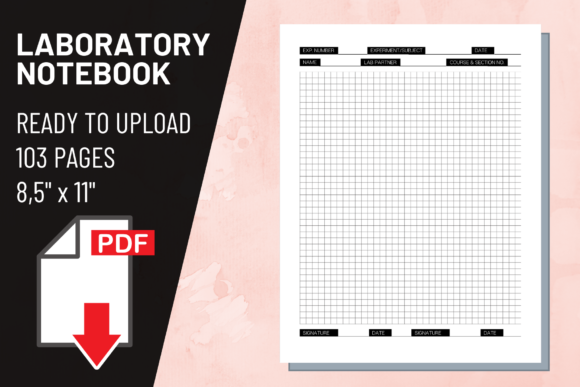
For self-publishers and niche content creators, sourcing reliable interiors is often the bottleneck in scaling a low-content or medium-content book business. The KDP Interior Laboratory Notebook discussed here represents a specific type of digital asset designed to streamline this process. Measuring 8.5″ x 11″ and comprising 103 pages, this pre-formatted PDF serves as a foundational tool for publishers targeting scientific, academic, and technical markets. Unlike generic lined journals, a laboratory notebook requires precise structural elements to be functional. This evaluation examines the practical utility, technical specifications, and market viability of this specific interior file for Amazon KDP publishing.
Technical Specifications and Print Readiness
The primary value proposition of any KDP interior is its technical compliance with printing standards. This Laboratory Notebook KDP interior is delivered as a high-quality PDF file at 300 dpi, which is the industry standard for crisp, professional print reproduction. At 8.5″ x 11″, the trim size aligns with the most common format for American scientific documentation and academic coursework. The 103-page count is a strategic choice; it provides substantial utility for the end-user while keeping the spine width sufficient for legible text when printed on demand.
A critical detail for publishers is the "no bleed" specification. In the context of a lab notebook, no bleed is often preferable. Scientific notebooks typically require generous margins for binding, hole punching, and handwritten annotations that must not be obscured by the gutter. A no-bleed interior ensures that all grid lines, headers, and data tables remain safely within the safe zone, reducing the risk of rejection during the KDP upload review process. This specification also simplifies cover design alignment, as creators do not need to account for wrap-around artwork extending into the trim area.
File Integrity and Upload Efficiency
When evaluating digital assets for publishing, file integrity is paramount. A 300 dpi resolution ensures that fine lines in graph paper or data entry fields do not appear pixelated or grayish when printed. Low-resolution interiors are a common cause of negative reviews in the scientific journal niche, as researchers require sharp precision for plotting data points. This file’s readiness for immediate upload eliminates the need for time-consuming reformatting in software like Adobe InDesign or Affinity Publisher. For entrepreneurs managing multiple SKUs, this reduction in pre-production time directly impacts profitability and workflow efficiency.
Functional Design and User Experience
Beyond technical specs, the success of a KDP Interior Laboratory Notebook depends entirely on its functional design. Scientists, students, and technicians do not buy these notebooks for aesthetics; they buy them for data integrity and organization. A viable interior must replicate the cognitive workflow of laboratory documentation. While specific layouts vary, effective lab notebook interiors generally include structured sections for experiment titles, dates, objectives, materials, procedures, observations, and conclusions.
The 8.5″ x 11″ format offers ample horizontal space for dual-column layouts, which are standard in professional research environments. This allows users to separate procedural notes from raw data or calculations. When assessing this interior, publishers should verify that the line spacing and box dimensions accommodate actual handwriting sizes. Overly dense formatting can render a notebook unusable in real-world conditions. The 103-page length strikes a balance between portability and capacity, making it suitable for semester-long academic courses or discrete project phases in professional R&D settings.
Meeting Niche Expectations
The target audience for this product possesses high standards for accuracy. Generic "science journals" often fail because they lack specific prompts or standardized fields. A professional-grade Laboratory Notebook KDP interior should facilitate Good Laboratory Practice (GLP) or at least mirror standard academic requirements. Publishers must critically evaluate whether the included templates match the expectations of their specific sub-niche. For example, a chemistry student has different layout needs than a field biologist. Understanding these distinctions determines whether this specific 103-page template will satisfy customers or generate returns.
Strategic Value for Publishers and Creators
For marketers, freelancers, and small business owners in the publishing space, this interior functions as a leverage point. Creating a scientifically accurate lab notebook from scratch requires domain expertise and significant design hours. Utilizing a pre-made, print-ready asset allows creators to focus on keyword research, cover design, and marketing strategy rather than interior typesetting. This is particularly relevant for publishers building a portfolio of educational supplements or professional tools.
- Time Efficiency: Eliminates 10–20 hours of interior design and formatting work per title.
- Risk Mitigation: Pre-verified dimensions and resolution reduce the likelihood of KDP quality alerts.
- Scalability: Enables rapid testing of different cover designs and keywords against a consistent, high-quality interior.
- Professional Presentation: Ensures the final physical product meets the tactile and visual expectations of academic buyers.
However, reliance on pre-made interiors requires a strategic approach to differentiation. Since other publishers may have access to similar assets, the competitive advantage shifts to the exterior presentation and metadata optimization. The interior provides the baseline quality; the publisher adds value through targeted positioning, such as branding the notebook for specific university programs, research disciplines, or hobbyist communities.
Practical Limitations and Considerations
While the KDP Interior Laboratory Notebook offers significant convenience, it is not a universal solution. Publishers must recognize its constraints to avoid misalignment with customer needs. The fixed 103-page count, while practical, may not suit all use cases. Some professional labs require archival-quality notebooks with 200+ pages, while quick-reference field guides might need fewer. Additionally, the no-bleed format, though safe, limits certain aesthetic choices. Publishers seeking full-page background textures or edge-to-edge graphics will need to source alternative files.
Another consideration is customization. As a static PDF, this interior cannot be easily modified without vector editing skills. If a publisher identifies a gap in the layout—such as missing safety checklists or insufficient graph space—they cannot simply adjust the template without specialized software. Therefore, this asset is best suited for publishers who find the existing layout perfectly aligned with their target market, or those willing to accept the standard format as-is. It is less ideal for creators who view the interior as a starting point for heavy modification.
Audience Fit and Market Positioning
This specific Laboratory Notebook KDP interior is most valuable for:
- Educational Publishers: Creating supplementary materials for high school AP sciences or undergraduate lab courses where standardized formatting aids grading and learning.
- Niche Non-Fiction Authors: Offering a companion workbook or data log to support broader scientific or technical books.
- Serial Low-Content Publishers: Expanding into the STEM category with a professionally vetted template rather than experimenting with unproven designs.
- Hobbyist Community Leaders: Providing structured documentation tools for homebrewers, citizen scientists, or electronics enthusiasts who desire professional-grade record-keeping.
Conversely, established stationery brands or publishers with proprietary layouts may find limited value here. The asset serves as an enabler for entry and expansion, not necessarily a replacement for bespoke product development at scale.
Assessing Long-Term Viability and Quality
In the evolving landscape of KDP publishing, quality thresholds continue to rise. Early low-content books succeeded with minimal effort; today’s market demands genuine utility. This 8.5″ x 11″ laboratory notebook interior supports that shift toward quality. Its 300 dpi resolution and thoughtful page count demonstrate an understanding of print production realities. For publishers committed to serving the scientific and educational communities, such attention to detail is non-negotiable.
Ultimately, the decision to utilize this KDP Interior Laboratory Notebook should be driven by audience analysis. If your research indicates demand for a standard-format, 103-page lab journal in the US letter size, this asset provides a reliable foundation. It removes technical barriers and allows publishers to deliver a product that respects the user’s professional or academic needs. By pairing this competent interior with differentiated covers and precise marketing, creators can build sustainable offerings in a niche that values substance over style. The true measure of this resource is not just its file specifications, but its capacity to help publishers serve a discerning audience with integrity and efficiency.